







The Master of Project Caesar: Grand Strategy and Socio-Economic Management in Europa Universalis V
The transition from the fourth installment to Europa Universalis V (internally known during development as Project Caesar) represents the most significant mechanical shift in the history of the grand strategy genre. Moving away from the abstract "Mana" systems of its predecessor, EUV introduces a simulation-heavy framework rooted in population dynamics, physical markets, and granular provincial logistics. To succeed in this new era, a player can no longer rely on clicking a button to instantly core a province or tech up. Instead, one must become a master of the "Socio-Economic Engine"—managing the literal people, or "Pops," that inhabit your borders. This article provides a deep-dive into the technical systems of EUV, offering a roadmap for transforming a medieval fiefdom into a global hegemonic power.
1. The Foundation of Pops: Navigating the Demographic Simulation
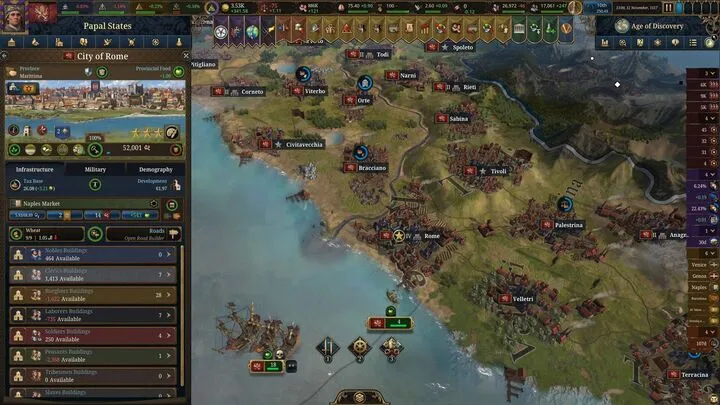
In Europa Universalis V, the heartbeat of your empire is the Population system. Unlike previous games where a province was just a number, here every location is populated by specific social classes: Peasants, Clergy, Nobles, Burghers, and Slaves. Each group has its own literacy rate, religious fervor, and economic needs. To optimize your early game, you must focus on Class Satisfaction. If your Peasants are starving because you’ve over-taxed their grain, your food production will plummet, leading to a death spiral of famine and revolt.
Understanding the "Malthusian Trap" is essential for mid-term planning. As your technology improves, your food supply grows, which in turn causes your population to explode. If you do not have the infrastructure—such as mills and expanded granaries—to support this growth, you will face massive unrest. A technical pro-tip is to use the "Internal Migration" edicts to push surplus Peasants from overpopulated urban centers into under-developed frontier provinces, ensuring that every acre of land is contributing to your tax base without triggering local overpopulation penalties.
2. Market Logistics: The Physics of Trade and Price Discovery
The trade system has been completely overhauled from a "Node-to-Node" flow to a "Physical Market" system. Every item, from Salt to Silk, has a physical location and a local price determined by supply and demand. To master the economy, you must understand Market Access. If a province has 0% Market Access, it cannot buy the goods it needs or sell the surplus it produces, effectively removing it from your national economy. This is often caused by a lack of roads or coastal ports.
Optimizing Your Trade Network
- The Hub-and-Spoke Model: Designate a central "Market Center" (like London or Paris) and prioritize road construction connecting it to high-resource provinces. This ensures that the high price of luxury goods in the capital "pulls" production from the countryside.
- Trade Ratios: Always monitor the "Input-Output" cost of your workshops. If the price of raw Iron exceeds the value of the finished Tools, your Burghers will go bankrupt, leading to a collapse in your industrial tech progression.
- Contraband Management: High tariffs encourage smuggling. If you set your trade taxes too high, you’ll lose your "Effective Revenue" to the black market, which benefits your rivals’ spy networks.
3. The Estates System: Managing the Social Contract
Power in EUV is not absolute; it is negotiated through the Estates. The Clergy, Nobility, and Burghers are not just static icons; they hold physical land and exert "Political Leverage." Your goal is to maximize Crown Authority without triggering a civil war. In the early 1337 start date, the Nobility will likely hold the majority of your power. You must use "Legal Reforms" to slowly strip their privileges, but doing so too quickly will tank your stability and invite foreign intervention.
Estate Privilege Strategies
- The Golden Compromise: Grant the Clergy "Educational Oversight" in exchange for a boost to Literacy. This pays off in the long run as higher Literacy speeds up your technological advancement.
- Burgher Loans: Avoid taking high-interest loans from foreign powers. Instead, use the "Burgher Credit" privilege to get low-interest capital in exchange for market monopolies.
- Nobiliary Levies: In the early game, rely on the Nobility for your army. As you transition to a professional standing army, you must revoke their "Right to Lead" to prevent your generals from being more loyal to their class than to the Crown.
4. Provincial Infrastructure: The Architecture of Bureaucracy
In Europa Universalis V, "Development" is no longer a button you click; it is something you build. Every province has a limited number of Building Slots, and your choices define the province's identity. A "Production Hub" requires a specialized chain: Mines, Smelters, and Toolmakers. If these buildings are not in the same Market or connected by high-level infrastructure, the "Transaction Cost" will eat your profits.
Infrastructure Hierarchy
- Roads: The most important early-game investment. Roads increase "Control," which directly translates to how much tax revenue actually reaches your treasury versus staying in local pockets.
- Fortifications: Forts now have a "Supply Draw." Placing a massive fortress in a low-supply desert province will cause your own garrison to starve. Always match fort level to local food production.
- Administrative Offices: These increase the "Bureaucratic Reach" of the capital, reducing the "Autonomy" of distant provinces and allowing you to draft more soldiers from the local population.
5. Military Logistics: The "Supply Train" and Attrition Math
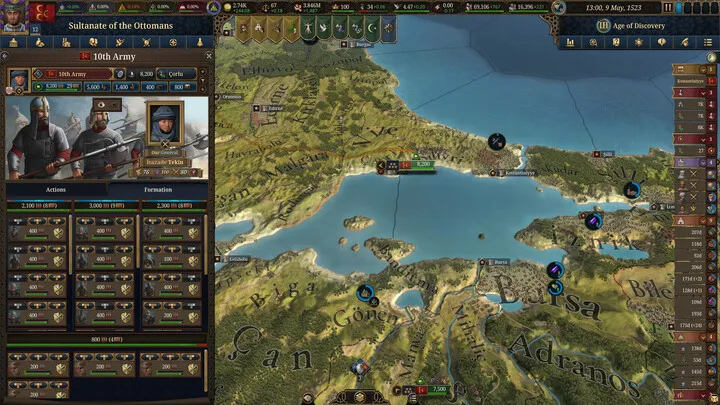
War in EUV is a battle of logistics, not just morale. Armies now require a constant flow of Food, Water, and Munitions. If an army moves too far from a friendly Market or a supply depot, they will suffer "Deep Attrition," which kills troops faster than any battle. You must master the "Sack and Forage" mechanics. When in enemy territory, your army can sustain itself by looting, but this destroys the local Pops and ruins the economy of the land you are trying to conquer.
Tactical Supply Management
- The Baggage Train: Always attach a supply unit to your main stacks. This acts as a mobile "Food Buffer" for three months of campaigning.
- Naval Blockades: If you are fighting a coastal power, blockades now prevent them from "Sea-Sourcing" food. You can effectively starve a city like Venice or Constantinople into submission without ever firing a cannon.
- Mercenary Contracts: Mercenaries provide their own supplies but cost significantly more gold. Use them for "Shock Siege" operations to preserve your national manpower for the long-term war of attrition.
6. Diplomatic Gravity: Alliances and the Balance of Power
Diplomacy in EUV operates on the principle of "Geopolitical Gravity." Large empires naturally pull smaller neighbors into their orbit through Diplomatic Influence. You can no longer simply "Royal Marry" your way into a Union easily; you must build up "Economic Dependence." By becoming the primary buyer of a neighbor’s main export, you gain a "Leverage Modifier" that makes them more likely to accept vassalization.
Strategic Diplomatic Tools
- Threat Perception: If you expand too fast, your neighbors' "Threat Meter" will spike, leading to a "Containment Coalition." To mitigate this, use "Diplomatic Missions" to improve relations during the war, not just after.
- Dynastic Ties: Marriages now create "Claimant Risks." If your dynasty is weak, a powerful ally might "Suggest" a successor, essentially turning your kingdom into a puppet state through bloodlines.
- Trade Leagues: For smaller nations, joining a Trade League is the only way to survive the physical market system, as it pools "Market Reach" and protects members from predatory pricing by empires.
7. Technological Evolution: The Literacy and Innovation Loop
Technology is no longer a linear race fueled by points; it is a "Diffusion" process. New ideas start in high-literacy urban centers and slowly spread to the countryside. To stay ahead, you must invest in Institutions and Universities. A high "Literacy Rate" among your Burgher and Clergy pops is the primary multiplier for tech speed. If your country is 90% illiterate peasants, even the best King will struggle to modernize.
Innovation Categories
- Administrative: Unlocks better taxation methods and more building slots. Essential for early-game stabilization.
- Diplomatic: Improves "Market Reach" and unlocks the ability to colonize via "Chartered Companies."
- Military: Unlike EU4, this focuses heavily on "Unit Drills" and "Supply Efficiency" rather than just flat damage bonuses. A tech-advanced army with no food will still lose to a primitive army in their home territory.
8. Religious Fervor and National Cohesion
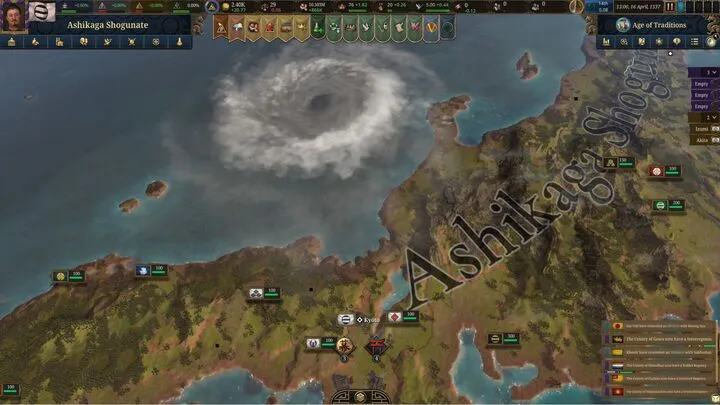
Religion is a physical force in EUV, represented by the Piety of your Pops. If a province has a different religion than the state, the "Unrest Modifier" scales with the religious fervor of that location. You have two choices: "Tolerance" or "Conversion." Tolerance is cheaper but lowers your "National Cohesion," making it harder to pass laws. Conversion is expensive and slow, as you must send "Missionaries" who physically move to the province and work with the local Clergy Estate.
Managing Religious Crises
- The Reformation Engine: The Reformation is not a scripted event but a result of "Printing Press" spread and "Clergy Corruption." You can delay it by keeping your Clergy Estate happy and literate.
- Syncretism: For empires like the Ottomans or Mughals, the "Syncretism" mechanic allows you to adopt the "Needs" of other religions into your own social contract, preventing massive revolts in conquered territories.
- Holy Sites: Controlling a Holy Site (like Rome, Mecca, or Jerusalem) provides a global "Prestige" and "Influence" boost, but it makes you a permanent target for "Crusade" or "Jihad" mechanics from rivals.
9. Colonization: The Physical Expansion and Colonial Range
Colonization has moved away from "Send Colonist and Wait." It is now an Extension of the Market. You must establish "Outposts" that physically draw supplies from the metropole. If your colonial range is too long, the "Supply Cost" will bankrupt your treasury. Furthermore, the indigenous Pops are no longer just "Aggression/Ferocity" numbers; they are active participants. You must choose between "Displacement," which clears land for your Pops, or "Integration," which uses the local Pops' knowledge of the terrain to boost resource extraction.
Colonial Efficiency Factors
- Distance to Capital: This creates "Communication Delay." High delay leads to high "Colonial Autonomy," eventually causing your colonies to form their own "National Identities" and demand independence.
- Resource Monopolies: Colonial goods like Cocoa and Tobacco provide massive "Market Power." If you control 50% of the world's Tobacco, you can dictate the price in all European markets.
- Naval Presence: Without a strong navy, your trade fleets will be picked off by pirates or rivals, cutting off your colonies from the market and causing them to collapse economically.
10. The Endgame: Total War and Global Hegemony
In the final centuries of the game, the simulation transitions from feudal management to Total War. As your "Nationalism" mechanic unlocks, your Pops become willing to fight for the "State" rather than just for their local Lord. This allows for massive "Levée en Masse" mobilization. However, the cost is staggering. A total war will depopulate your farms and empty your markets, potentially leading to a "Revolution" if the war drags on too long without a clear victory.
The final challenge is maintaining your "Hegemony." Once you are the top-ranked power, every other nation will receive a "Balance of Power" modifier against you. You must use your "Influence" to keep your rivals fighting each other. If you allow two of your rivals to form a "Super-Alliance," your global trade dominance will be threatened. Success in the endgame is not about taking more land, but about ensuring that no other power can challenge your "World Market" dominance.
Conclusion
Europa Universalis V is a game of deep, interconnected systems where the smallest change in a provincial grain price can lead to the fall of a dynasty. By focusing on the physical reality of your population, the logistical needs of your military, and the complex social contract with your Estates, you can navigate the turbulent centuries from the Middle Ages to the Enlightenment. There are no shortcuts in Project Caesar; there is only the slow, rewarding work of building a state that can withstand the tests of time. Master your Pops, secure your markets, and your empire will be the one that defines history.